
Patient Blood Management and Perioperative Care (PBMPC)
Summary
The Patient Blood Management & Perioperative Care Health Informatics Collaborative (PBMPC HIC) brings together routinely collected NHS data to understand and improve care for patients with anaemia or bleeding, and those who may need a blood transfusion. The resource contains data relating to more than 3.3 million patients from five NHS Trusts, linking detailed information about transfusion and perioperative care with patient characteristics and outcomes. It is being used to study how blood is used in routine care, understand variation between hospitals and patient groups, and identify opportunities to improve care.
Background
Patient Blood Management (PBM) aims to improve patient outcomes by preventing and treating anaemia, reducing avoidable bleeding and ensuring that blood transfusion is used appropriately. Despite strong evidence and national guidance, important variation in transfusion and PBM practice remains between hospitals and patient groups.
Improving how blood is used and understanding which patients benefit from transfusion are national and international priorities. The World Health Organization (WHO) has called for wider implementation of Patient Blood Management, while the James Lind Alliance Blood Transfusion and Blood Donation Priority Setting Partnership identified important unanswered questions about how transfusion can be used more safely and effectively. More recently, the Infected Blood Inquiry has reinforced the importance of effective oversight, data sharing and learning across the transfusion pathway.
Routinely collected NHS data provide an opportunity to address these priorities by showing how transfusion and PBM are delivered in real-world care, where practice varies, and how different approaches relate to patient outcomes.
The PBMPC Health Informatics Collaborative
PBMPC HIC has been developed as part of the NIHR funded Blood & Transplant Research Unit in Data-Driven Transfusion Practice. The database is based at Oxford University Hospitals NHS Foundation Trust (OUH) and brings together routinely collected NHS data on anaemia, transfusion and perioperative care for research and healthcare improvement.
Launched in December 2024 this resource now contains data relating to more than 3.3 million patients from five major NHS Trusts, spanning multiple hospital sites and different electronic health record and transfusion systems. A particular strength of PBMPC HIC is the combination of detailed transfusion information with data on patient characteristics, laboratory results, procedures, treatments and clinical outcomes. This allows us to study not only who receives blood, but the circumstances in which transfusion occurs and what happens to patients afterwards.
Bringing together data and expertise from hospitals using different digital systems is also helping us understand how routinely collected NHS data can be harmonised and reused for research, audit and improvement.
What are we using the data to investigate?
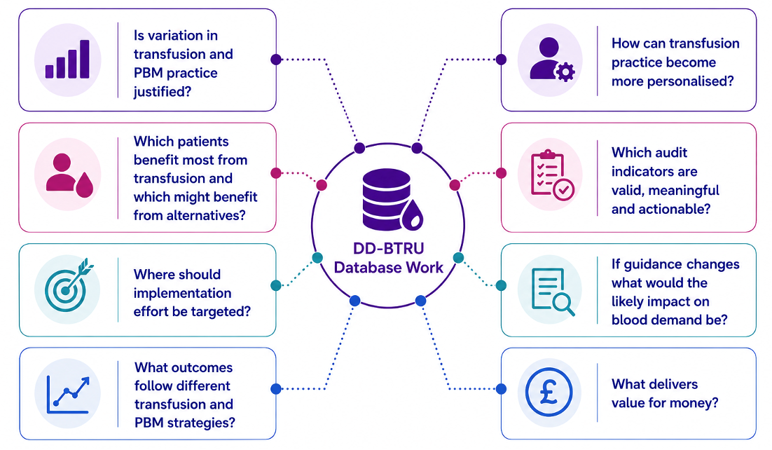
PBMPC HIC supports research to:
- understand how blood transfusion and Patient Blood Management are used in routine NHS care;
- identify variation between hospitals, clinical pathways and patient groups;
- assess whether care is consistent with evidence and national guidance;
- examine relationships between anaemia, transfusion, treatments and patient outcomes;
- investigate inequalities in care and outcomes;
- develop automated approaches to clinical audit and monitoring;
- develop methods for using routinely collected NHS data to support research and improvement across different hospital systems;
- support benchmarking and quality improvement; and
- provide a platform for observational research, implementation studies and future data-enabled clinical studies.
From data to improvement
Collecting and harmonising data is only the first step. An important focus of our work is making these data useful to researchers, clinicians and healthcare services. We are developing methods to turn routinely collected hospital data into clinically meaningful measures of practice. Current work includes monitoring perioperative use of tranexamic acid (TXA), understanding variation in transfusion and anaemia management, and developing automated approaches that could complement resource-intensive manual audits.
We are also working with the Thames Valley and Surrey Secure Data Environment to develop regional data flows and explore how routinely collected data can support research, benchmarking and useful feedback to clinical teams. Our longer-term aim is to support a learning health system for transfusion and Patient Blood Management, where information generated during routine care can be used to identify variation, evaluate improvement and inform future research.
Who we are
PBMPC HIC is based at Oxford University Hospitals NHS Foundation Trust and has been developed by a multidisciplinary research team based across multiple NHS trusts and universities led by the University of Oxford. The work forms a major part of the work of the NIHR Blood and Transplant Research Unit in Data-Driven Transfusion Practice. The team brings together expertise in transfusion medicine, perioperative care, health data science, statistics, implementation science and health economics.
Patients and members of the public are closely involved throughout the programme, helping to set research priorities, develop studies, interpret findings and shape how health data and research findings are communicated and used.
The PBMPC HIC collaborative.
PBMPC HIC brings together clinicians, researchers, data specialists and NHS partners across participating hospitals and universities. Working across different clinical settings and digital systems allows us to develop research questions collaboratively and learn how routinely collected data can be used consistently across the NHS.
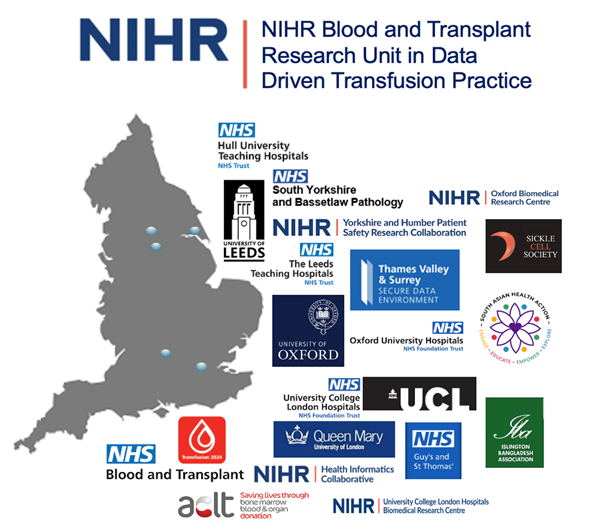
Collaborating NHS Trusts
Data have been contributed by:
- Oxford University Hospitals NHS Foundation Trust
- Hull University Teaching Hospitals NHS Trust
- University College London Hospitals NHS Foundation Trust
- Leeds Teaching Hospitals NHS Trust
- Guy’s and St Thomas’ NHS Foundation Trust
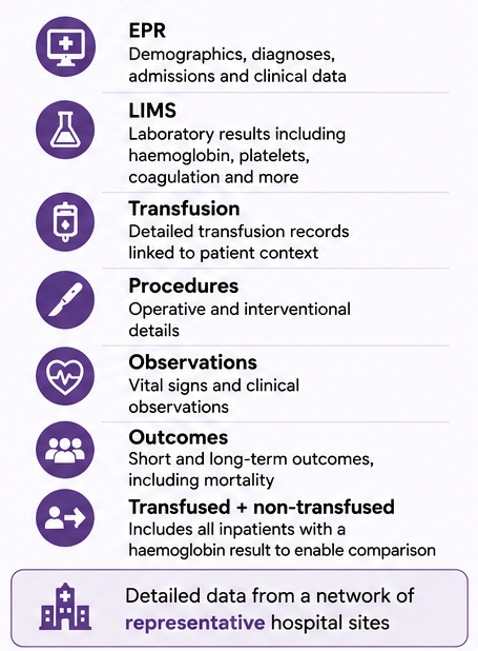
Data included in PBMPC HIC.
The resource brings together information across the perioperative and transfusion pathway, including patient characteristics, laboratory results, procedures, treatments, transfusions and outcomes.
Research enabled by PBMPC HIC. The scale and detail of the resource allow us to study transfusion and Patient Blood Management across different patients, clinical pathways and hospitals, and to move from describing variation towards understanding outcomes and improving care.
Get in touch: Dr Hayley Evans Deputy Director DD-BTRU hayley.evans@ndcls.ox.ac.uk